Umbwe Route Guide: Kilimanjaro's Toughest Path
David M.
Lead Expedition Guide
The Umbwe Route is Kilimanjaro's toughest path. Discover success rates, itineraries, and expert warnings. Take our success predictor quiz to see if you are ready!
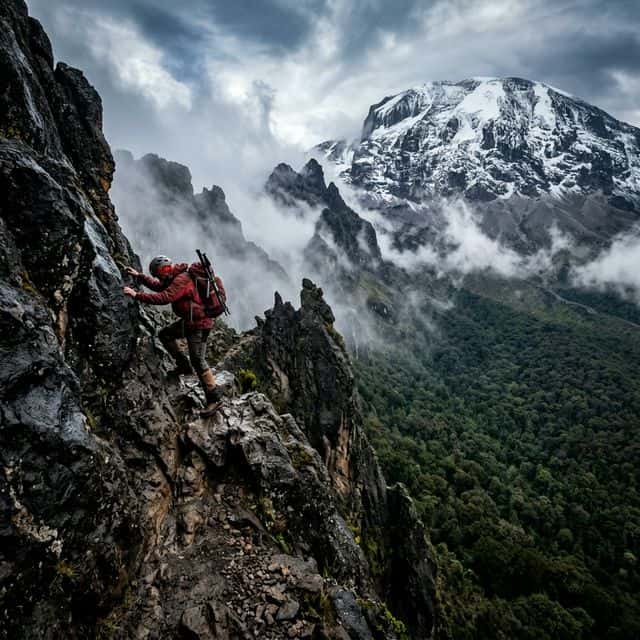
The Umbwe route is the most challenging, shortest, and steepest path on Mount Kilimanjaro. It is not for the faint of heart or the inexperienced. This guide breaks down why this path is legendary and who should actually attempt it.
A Reality Check
The Umbwe Route is often called the "direct" route. Unlike the Lemosho or Machame routes that wind around the mountain to aid acclimatization through a "climb high, sleep low" strategy, Umbwe goes straight up.
This creates a spectacular but punishing trek that should only be attempted by those who are extremely fit and have previous high-altitude experience. If your goal is primarily to reach the summit, this is statistically the most difficult way to do it. The Tanzania National Parks (TANAPA) regulations require all climbers to be accompanied by a licensed guide, and on Umbwe, that expertise is more critical than anywhere else.
Success Rate: ~60%
Due to the rapid ascent, many climbers struggle with Acute Mountain Sickness (AMS). It has one of the lowest summit success rates on the mountain compared to the 95%+ of the Northern Circuit.
Steepness: Extreme
You'll be using your hands for balance in several sections during the first two days in the rainforest. The vertical gain is relentless.
The Reputation
Historically, the Umbwe route was used for descent or by elite mountaineers looking for the "Western Breach" approach—a dangerous and now rarely used path over the ice. Today, most Umbwe hikers join the standard southern circuit at Barranco Camp after two days of intense climbing.
Why Climb Umbwe?
If it's so hard, why do people do it? The rewards are as extreme as the challenge:
Total Solitude
You see almost no other climbers for the first 48 hours. It feels like a private expedition in the dense jungle.
The Western Breach Views
The early morning views as you emerge from the tree line are the most dramatic on the mountain. The scale of the Kibo peak is overwhelming.
Navigating the Climate Zones
On most Kilimanjaro routes, you experience the transition through five ecological zones gradually. On Umbwe, you "blast" through them.
- Rainforest (1,600m - 2,800m): Extremely humid and muddy. You'll gain nearly 1,200m in a single day.
- Heather and Moorland (2,800m - 4,000m): The trees thin out, exposing you to the sun and the first real views of the crater rim.
- Alpine Desert (4,000m - 5,000m): By Day 3 (Karanga Camp), you are in a desolate, rocky landscape where nighttime temperatures drop below freezing.
Expert Warning from KiliGo
We do not recommend the Umbwe route for beginners or anyone who hasn't climbed above 4,000 meters before. If this is your first "big mountain," please consider our Lemosho 8-day guide or the Northern Circuit. Acclimatization is a biological process that cannot be rushed by fitness alone.
Specific Training for Umbwe
If you are determined to tackle the Umbwe route, your training must go beyond standard cardio. You need "vertical endurance."
- Weighted Ascent: Practice with a 12kg-15kg pack on the steepest grades you can find. Your goal is to build the muscular endurance to lift that weight for 6+ hours a day.
- Core Stability: The uneven terrain requires significant core strength to prevent injury and save energy. See our 12-week training plan for specific exercises.
- Leg Strength: Focus on concentric (climbing) and eccentric (descending) loading. The descent is as hard on the knees as the ascent is on the lungs.
The Typical Itinerary (7 Days)
Most responsible operators run Umbwe as a 7-day trek to allow for at least one extra day of acclimatization:
| Day | Route Section | Altitude Gain |
|---|---|---|
| Day 1 | Umbwe Gate to Umbwe Cave Camp | +1,200m |
| Day 2 | Umbwe Cave Camp to Barranco Camp | +1,100m |
| Day 3 | Barranco Camp (Acclimatization) | 0m (Short Hike) |
| Day 4 | Barranco to Karanga Camp | +150m (Climbing Barranco Wall) |
| Day 5 | Karanga to Barafu Camp (Base Camp) | +600m |
| Day 6 | Summit Night (Uhuru Peak) & Mweka | +1,200m / -2,800m |
Frequently Asked Questions
Is the Umbwe route technical?
No. You do not need ropes or mountaineering equipment, but you will need to "scramble" using your hands for balance in steep rock sections.
Is it more dangerous than other routes?
The physical danger of falling is low, but the risk of severe altitude sickness is higher than on any other route due to the rapid ascent rate.
Can I join a group on Umbwe?
Most Umbwe climbs are private because of the specialized nature of the route. Very few operators offer fixed-date group departures for this path.
Conclusion: Success or Suffering?
The Umbwe route is a masterpiece of mountain terrain, but it expects a high level of respect. It’s hard, it’s fast, and it’s beautiful. If you’re ready for the challenge, it provides the most visceral connection to Mount Kilimanjaro. If you aren't sure, don't risk your safety—opt for a longer route.
Not sure if you're ready?
Take our Personal Success Predictor to see which Kilimanjaro route matches your fitness and experience profile.
Take the Predictor Quiz